Dan
Biferie founded what is now known as 'The Southeast Museum for
Photography.' This is a place I first volunteered at, later worked
for, and has now became a sponsor for Curating the Unseen. The
link between this compassionate, talented photographer and this
blog have roots that extend far deeper than that.
He
was, and remains, the Dean of the Southeast Center for Photographic
Studies, my alma mater. In fact, he personally preformed my
acceptance interview and gave me my first tour. In my first semester
I was accepted into his "merit program" along with all the
other type A personalities. We met at 8 in the morning for class and
he factually explained to his thrilled, but nervous students that a C
is average and an A is above and beyond. We would have to work for an
A.
He
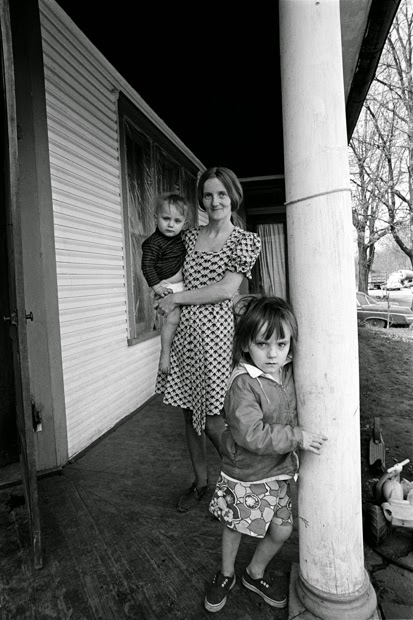
then showed us the work in this post along with another series, his
“Churchscapes”, that will also be appearing on the blog.
For
so many of us, Dan Biferie was the introduction to our new home, the
building we would live, eat, work, and very often sleep in (there are
many couches in the student break room for this). He opened his arms
to every student that came through the doors and stuck with those of
us that opened up in turn.
I
would not have graduated without him holding my hand through two
particular low points in my life at that time. Dan was there to see me at my worst
as well as at my best and I know I was not the only one. He is
genuine, and kind, and literally one of the first photographers I
thought of when I created CtU. His portraits, like the photographer, are warm, intuitive, and often funny.
"My grandmother gave me her Brownie camera when I was 12 years old. I still have three treasured photographs that were taken over 50 years ago with that first camera. As my interest expanded, I bought a film processing kit from a Sears and Roebuck mail-order catalog. As a young boy I dreamed to follow in the footsteps of Peter Gowland, Bunny Yeager, and other glamour photographers of that era."
"This series was photographed primarily with a Nikon Photomic FTN camera and a 24mm lens; a gift from my grandmother in 1969. I also worked with a Hasselblad 500C, with which I made one of my all-time favorite photographs, “Trout Man.” Tied for first place is “Mr. Keyes,” which was taken with the Nikon. The Nikon was a solid camera, a workhorse that took me up to the digital age twenty-five years later."
"Joe Crumley, my first semester teacher at Daytona Beach Junior College, was the most influential person in my foundational years in photography. Joe was passionate about photography and teaching. I mention this because one does not need to have a renowned artist to have a great teacher, or be enrolled in an elite photography program to obtain an excellent photographic education.
My earliest influences in documentary photography included Arthur Rothstein and all of the photographers of the Farm Security Administration, Wright Morris, Robert Frank, Bruce Davidson, Lee Friedlander, Henri Cartier-Bresson, Eugene Smith, Gary Winogrand, Diane Arbus, Bill Brandt, Helen Levitt, and August Sanders among many others."
"As I approached my subject, I would identify myself as a photography student who was interested in photographing people in their environments. I would ask them about the town, their business, and themselves. As I was photographing I would tell them what I was doing and why I was taking several photographs. If the camera was on a tripod I would let them look in the viewfinder to show them what I was seeing. Engaging the subject in conversation was what was most important. I was rarely ever turned away.
I prefer taking a directorial approach to my environmental portraiture. When I assisted Arnold Newman during a workshop at the college I remember him saying how he considered the person he was photographing as an element in a still life. He would direct the person or take the liberty to move elements in the photograph slightly to create his composition. I have made only two candid photographs in all of my years as a photographer."
"I concentrated on photographing in small towns, and often returned to photograph the same areas or the same people. I would bring back photographs from previous shoots to show them what I had done and leave the photographs behind as a gift. I photographed Mr. Keyes on three separate occasions and eventually my wife and I became good friends with Harry Sines who is portrayed in another one of my favorite photographs.
I don’t believe that most people liked the kind of photographs that I was taking. I eventually figured out that I would make a photograph that they would like; nice lighting, telephoto lens, simple background and a smile. I shot this parting photograph with a Polaroid camera so that I could leave the print behind.
The most memorable reaction to my work was when I returned to Favoretta, Florida after several months to give a print to a kind old man whom I had photographed earlier. A little girl stood outside of the house and I showed her the photograph that I had taken of her grandfather. She ran inside and brought out her mother, who was crying when she saw the picture. Her father had died and this was the only photograph that was ever taken of him. I realized then, more than ever before, how powerful a photograph can be and that the most treasured photographs are those that mean something personally to us."

"Since I like to photograph and I like people it was logical that I would be attracted to the human subject. The documentary photographs from the Farm Security Administration contributed to my interest in environmental portraiture. The photographs, which are presented here in Curating the Unseen, were taken in small towns or rural areas, where time seems to stand still. People are friendly, approachable and freely tell their stories."
"I have actually gone full circle with my work since transitioning to digital from film. My earlier digital work was manipulated in Photoshop. I would alter the landscape or church in the photograph for example, working toward a plausible result. Now I am concentrating on my documentary work, primarily in black and white. My style has always been consistent over the years, and clearly established in traditional photography.
Recently I have been archiving my earlier work, scanning the 35mm negatives, refining them in Photoshop and outputting them as digital prints. The digital work is superior to my silver prints. The controls that I have now, compared to working in the darkroom, are highly sophisticated and allow me to bring out qualities that were not possible before. It is unlikely that I will ever work in the darkroom again."
"In 1994 I had applied for a sabbatical leave at the college. My proposal was based upon my photographic work. The vice-president at the time told me that the college wasn’t going to fund my taking pictures. He suggested that I look in a different direction. My new proposal was based upon learning about digital photography, computer technology and the internet.
Within weeks after starting the project I became enthralled with working digitally. The first photographs were taken with Kodak’s DCS, the first professional digital camera which became available in 1991. It was a Nikon camera with digital components tethered to a very heavy shoulder-mounted processing and storage unit. The file size was 1.2 MB and I used Adobe Photoshop version 3.0 to manipulate the image, working on an Apple Macintosh Performa computer. Digital photography still had a long way to go but I could see my future in it at the time."
"The School of Photography was originally part of the Mary Karl Vocational School in Baker Hall. Our program was housed along with the Print Shop, Small Engine Repairs, Air Conditioning, Dry Cleaning and Woodworking.
In 1978, my third year at the college, I applied for a small grant to have two large display cases built for the hallways of Baker Hall. My goal was to create an exhibition space where we could display photographs by students from other colleges, to expose my students to original work beyond our program. From there the display moved to the library, where there was higher traffic and visibility. The walls and case became known as the Standing Room Only Gallery. I showed the work of a number of photographers who are now well established. Two years later I convinced the college president to establish the DBCC Gallery of Fine Arts in a space that was originally designed to serve as the green room for the theater in the newly built Goddard Center for the Arts. We had about 150 running feet. Our first show in 1979 was a retrospective exhibition of the work of Dorthea Lange.
Kathy, my wife, and I worked together as a team for the first twelve years of the gallery; she was the curator and I was the director. We did not receive any compensation for our work during the first few years and had a very small budget to work with. We depended on our students, who served as volunteers, and on the generosity of our administration and community to operate the gallery.
During the formative years of what has now become the Southeast Museum of Photography, we presented over 500 different exhibitions and programs, established a permanent collection, organized workshops and artist in residence programs. Guest photographers included Robert Frank, Jerry Uelsmann, Emmet Gowin, Ruth Bernard, Arthur Rothstein, Marion Post Wolcott, Arnold Newman, Lee Freidlander, Barbara Morgan, Robert Rauschenberg, Eddie Adams, Mary Ellen Mark, and Yousuf Karsh, among many others. We received state and national grants from the Florida Division of Cultural Affairs, Florida Endowment for the Humanities, National Endowment for the Arts, and Institute of Museum Services to support our programs.
In 1989 we planned for a new museum, rallied community support, helped get a $750,000 state grant to build it and even worked with architects to design it. By then we had amassed a permanent collection of 3,000 photographs. I resigned shortly after announcing the establishment of the Southeast Museum of Photography. I realized that I had taken it as far as I wanted to and elected to return to teaching full-time where my real passion was.
Allison Nordstrom was the director who moved the gallery into its new home in 1992. Kevin Miller took over the helm after her and was instrumental in the move to a new $11,500,000 facility. His direction has been more in line with my original vision. Last fall, Professor Miller returned to the School of Photography as a full-time faculty member. Juliana Romnes is now the museum’s Interim Director, having previously served as its Exhibitions Coordinator for the past eight years.
Quite honestly I am humbled by the fact that my wife and I are a part of the museum's 35 year history. We took a leap of faith, followed our instincts, and worked with a team of dedicated individuals who believed in what we were doing. They were from every level at the college and included administrators, board members, faculty, students, volunteers from the community, and many friends of photography. They helped us to shine, and many of our supporters possessed skills and experiences that we were lacking in, further contributing to the museum’s success."


"I am a teacher, coach, and advocate for our students at the Southeast Center for Photographic Studies, a partnership between Daytona State College, University of Central Florida-Daytona Photography Program, and the Southeast Museum of Photography. I place my emphasis on both the form and the content of the images that my students produce. The technical skills are the easiest areas to teach, and they are needed in order to help the students to be able to realize their ideas and images. I emphasize both the art and the craft of making the photograph and I hope to instill my passion for lifelong learning and my deep respect the work itself."

"Teaching has influenced my personal work. I am in the classroom eight hours a week talking about photography, looking at and making photographs, sharing ideas and introducing my students to work by contemporary and historical photographers. We also explore digital imaging, technology, art, personal expression, life in general, etc. Beyond that, I spend several hours preparing for class and even more time thinking about and producing my own work (which often takes back seat to my teaching and administrative responsibilities). The interactions with my wife, who is also an artist, students, colleagues, and guest photographers also influences my ideas and my work. This immersion in the medium has had a profound effect upon me."

"The advice that I would give to my younger self would be to photograph everything, without any concern for whether or not it is art or part of a larger, cohesive body of work. Ultimately every photograph that I have taken has found its place as a piece of a puzzle that has finally taken form after some 45 years of photographing. Work that didn’t interest me, or made no sense at the time, now has a place in the larger picture of my life as an artist."